
Table of Contents
What Counts as Cyber Crime, and Where to Report It
Cyber crime is any crime committed through a computer, a phone or the internet. The most common is online financial fraud: UPI fraud, card and net banking fraud, fake investment, job and loan apps, and digital arrest scams. Others include hacking and account takeover, sextortion and blackmail, online harassment and stalking, impersonation and fake profiles, and the sharing of child sexual abuse or rape content.
Almost all of it is reported in one place: the National Cyber Crime Reporting Portal (NCRP) at cybercrime.gov.in, run by the Indian Cyber Crime Coordination Centre (I4C) of the Ministry of Home Affairs. The portal does not investigate. It forwards your complaint to the police of the state or union territory you select, and their cyber cell or cyber police station takes it from there. A few situations have a better first stop:
| Your situation | Where to report | How fast |
|---|---|---|
| You lost money: UPI, card, net banking, wallet or a fake investment app | Call 1930, then complete the complaint on cybercrime.gov.in; report the transactions to your bank | Immediately. Every hour lets the money move further. |
| Hacked account, sextortion, impersonation, harassment or a fake profile | cybercrime.gov.in, Report a Crime; also report it to the platform | As soon as you have saved the evidence |
| Child sexual abuse material, or rape or gang-rape content | cybercrime.gov.in, Report Anonymously (no personal details needed) | Immediately. Do not download or forward the content. |
| A scam call, SMS or WhatsApp message, with no money lost | Chakshu on sancharsaathi.gov.in | Within 30 days of receiving it |
| A transaction on your account that you did not make | Your bank, and 1930 | Within three working days of the bank’s alert (the rule changes on 1 January 2027, see below) |
| A hacked website, server or company system | CERT-In, at [email protected] | Companies and other organisations must report within 6 hours of noticing |
| Someone is in immediate danger | 112 | Now |
Lost Money? What to Do in the First Hour
Stolen money is moved through layers of mule accounts within minutes to hours. The Citizen Financial Cyber Fraud Reporting and Management System sits behind 1930. It sends your cyber fraud complaint to the banks and wallets the money passed through, so that they can put it on hold. A hold is what makes recovery possible later. Nothing else does, so the order of the next steps matters.
- Call 1930. Have ready the amount, the date and time, how you paid, the transaction reference (UTR) and the UPI ID, account number or wallet the money went to. The call is logged as a complaint and you receive an acknowledgement number by SMS.
- Call your bank’s fraud line, or use its app, to block cards, UPI and net banking. Ask for each transaction to be recorded as fraud and note the bank’s complaint reference.
- Complete the complaint on cybercrime.gov.in the same day. When the helpline was launched in 2021, callers were asked to submit full details on the portal within 24 hours using their acknowledgement number. The online complaint is where your evidence and the suspect’s details sit, so do not leave it at the phone call.
- Get an FIR. In 18 states and union territories (as of July 2026), a large enough loss is registered automatically as an e-Zero FIR, and you then have three days to visit the cyber police station and convert it into a regular FIR. Each state sets its own threshold. The scheme began in Delhi in May 2025 at ₹10 lakh, and Delhi has since lowered it to ₹1 lakh. Anywhere else, or below the threshold, file an FIR at your local or cyber police station and quote your acknowledgement number. You will need the FIR later too: restoring more than ₹50,000 held in any one bank requires one.
- Stop talking to the fraudster, and do not pay anyone who offers to get the money back for a fee.
If the money went through a digital arrest call, the same steps apply. The person on the video call was not an officer, and no agency will ask you to keep the matter secret from your family or your bank.
How to File a Complaint on cybercrime.gov.in, Step by Step
The portal’s current version (2.0) groups everything under one Report Cyber Crime menu with four options: Report a Crime, Track Your Complaint, Report Anonymously and Report Abuse to Social Media.
- Type cybercrime.gov.in into the browser yourself. Do not follow a link from a message, a search ad or a social media page.
- Choose Report a Crime and accept the terms.
- Sign in with your mobile number. Request an OTP and enter it with the captcha. First-time users register with their name and a valid Indian mobile number; the OTP is valid for 30 minutes.
- Describe the incident: what happened, when, and the website, app, platform or bank involved. Select your state or union territory carefully, because it decides which police force receives the complaint.
- Add what you know about the suspect: phone numbers, UPI IDs, bank account numbers, website addresses, social media profile links and email addresses.
- Upload your evidence (see the checklist below).
- Submit, and save the acknowledgement number together with a screenshot of the confirmation.
Financial fraud complaints
List every transaction separately: the bank or wallet, the transaction ID or UTR, the date and the amount. If money left in several transfers, each one is a separate trail that the banks have to follow. If you already called 1930, file against the same incident so that the two records match.
Other cyber crime: hacking, harassment, sextortion
Report the account or content to the platform as well, using its own reporting tools; the portal also has a Report Abuse to Social Media option. In sextortion cases, do not pay: payment rarely ends the demands. Save the messages and the profile link first, then block. If an email or social account was taken over, recover it and change the password before anything else, and check whether the same password was used elsewhere (see credential stuffing).
Reporting anonymously
Child sexual abuse material and rape or gang-rape content can be reported without giving any personal details. The anonymous form asks for the state, district and police station concerned and the details of the content. The trade-off is that an anonymous report cannot be tracked. If you want updates, use the named Report and Track route instead.
Logging in: the only official address
“Cyber police portal”, “NCRP portal login”, “cybercrime.gov.in login” and the common misspelling “NCCRP” all lead to the same site: cybercrime.gov.in. Sign-in uses your mobile number, an OTP sent to it and a captcha. Never share a bank OTP, PIN or card number with anyone who calls about your complaint, and treat any “cyber cell” number found in an ad or a social media post with suspicion.
Evidence to Keep Before You File
Collect this before you block anyone or delete anything. Police and banks act on what you can show.
- Money trail: bank statement, transaction receipts and UTR numbers, card receipts, and the UPI IDs, account numbers and IFSC codes you paid into.
- Messages: screenshots of chats, SMS and emails with the sender’s number or address visible, plus chat exports where the app allows it.
- Calls: the numbers that called you, with dates and times from your call log.
- Online traces: the addresses (URLs) of fake websites, apps and profiles, and screenshots of them, because they are often taken down within days.
- Documents you were shown: fake notices, warrants, ID cards or investment statements.
- Images and videos relevant to the crime, kept unedited.
Do not delete the chats, do not reset or replace the phone, and do not confront the suspect. If an email is central to the case, keep the original message, not just a screenshot, because its headers show where it really came from (see email spoofing).
How to Check Your Cyber Crime Complaint Status
- Open cybercrime.gov.in and choose Track Your Complaint.
- Enter your acknowledgement number.
- Request the OTP and enter it with the captcha.
Complaints made through Report Anonymously cannot be tracked. Holds on your money are notified separately, by SMS. If things seem stuck, the right next step depends on what is stuck:
| Situation | What to do |
|---|---|
| You received an SMS that money has been put on hold | Apply on the Money Restoration portal (next section). Holds do not turn into refunds on their own. |
| The investigation shows no progress | Visit the cyber police station of your district with the acknowledgement number and ask for the FIR number and the investigating officer. |
| Your bank has not acted on your fraud report | Complain to the bank in writing, then to the RBI Ombudsman if there is no reply in 30 days (see below). |
| Your own account was frozen because of someone else’s complaint | The Grievance Redressal Module, working since April 2026, handles grievances about frozen accounts and amounts marked as lien. |
Getting Held Money Back: The Restoration Process
A hold is not a refund, and the Government’s own figures show the gap. Across the financial years 2023-24 to 2025-26, more than ₹9,079 crore was marked as lien in fraud complaints, while refunds to victims stood at more than ₹206 crore (Rajya Sabha, July 2026). Before 2026, releasing held money generally needed a court order.
Since April 2026, a Money Restoration Module lets victims apply online. It works like this:
- Wait for an SMS confirming that an amount has been put on hold against your complaint. Only held money can be restored.
- Open mrm-ncrp.mha.gov.in and raise a refund request.
- Enter the 14-digit acknowledgement number from your NCRP complaint and verify the OTP.
- Upload a copy of your PAN card and give the bank account details for the refund.
- Note the request ID (it starts with “MR”) to follow it up.
Where up to ₹50,000 is held in a given bank, restoration may proceed without an FIR. Above that, an FIR is mandatory, which is one more reason to register it early. Money that had already moved beyond the accounts that were frozen cannot be restored through this route. In August 2026 the Supreme Court directed every state to operationalise its money-restoration process.
Your Bank and the RBI Rules
Separately from the police complaint, your bank has duties under the Reserve Bank of India’s rules on unauthorised electronic transactions. What you can claim depends on how fast you report, and the rules change on 1 January 2027.
| Rule | Until 31 December 2026 (RBI, 2017) | From 1 January 2027 (RBI, June 2026) |
|---|---|---|
| Zero liability when neither you nor the bank was at fault | Report to the bank within three working days of receiving its alert about the transaction | Report within five calendar days of the fraud |
| Reporting later | Days 4 to 7: your loss is capped at ₹5,000 to ₹25,000 depending on the account; after that, the bank’s board-approved policy applies | Set out in the new directions; ask your bank which case applies |
| You shared an OTP, PIN or password | Treated as customer negligence: you bear the loss until you report it | Approvals given “under coercion or duress”, and credentials obtained by fraud, are now within the definition of a fraudulent transaction |
| Small-value compensation | None | 85% of the net loss or ₹25,000, whichever is less, once in a lifetime, for frauds up to ₹50,000, if reported to 1930 or the NCRP and to the bank within five calendar days; covers frauds in the first year of the new rules |
| Time for the bank to resolve | Money credited back provisionally within 10 working days of your report; complaint resolved within 90 days | 45 calendar days for domestic transactions |
If the bank does not reply within 30 days, or you are not satisfied with its reply, complain to the RBI Ombudsman at cms.rbi.org.in. Under the Integrated Ombudsman Scheme, 2026, in force since 1 July 2026, you have 90 days from that point to file.
Banks can be made to pay where they failed you. The ombudsman has ordered banks to compensate a victim whose bank ignored obvious warning signs (see our digital arrest guide). On 29 October 2026 the Supreme Court said the RBI’s new rules must require banks to compensate victims, at no less than the amount lost, where a fraud happened because the bank failed in due diligence. The RBI’s amended KYC directions are due to be notified by 30 November 2026.
The Numbers
The Ministry of Home Affairs reports these figures to Parliament from the NCRP and the 1930 system. They count reported complaints only; many victims never file.
| Year | Financial fraud complaints on the NCRP | Amount reported lost |
|---|---|---|
| 2021 | 2,62,846 | ₹551 crore |
| 2022 | 6,94,446 | ₹2,290 crore |
| 2023 | 13,10,357 | ₹7,465 crore |
| 2024 | 19,18,835 | ₹22,848 crore |
| 2025 | 24,02,579 | ₹22,495 crore |
Source: Rajya Sabha Unstarred Question 1341, 11 February 2026. The Ministry notes that the data is dynamic.
Complaints grew about nine times in four years and losses about forty times, levelling off in 2025. The 1930 system’s running total of money “saved”, meaning put on hold, shows why reporting quickly pays:
| As of | Money held through 1930 and the NCRP | Complaints | Source |
|---|---|---|---|
| 31 December 2025 | ₹8,189 crore | 23.61 lakh | Rajya Sabha, February 2026 |
| 31 January 2026 | ₹8,690 crore | 24.65 lakh | Rajya Sabha, March 2026 |
| 30 June 2026 | ₹11,158 crore | 32.80 lakh | Rajya Sabha, July 2026 |
How India's Cyber Crime Reporting System Has Built Up
The milestones behind today's reporting routes, from the portal's launch to the latest court order.
-
Indian Cyber Crime Coordination Centre
Reporting portal launched
The National Cyber Crime Reporting Portal opened on 30 August 2019 for child sexual abuse and rape content, and was extended to all cyber crime in January 2020.
I4C -
Ministry of Home Affairs
Fraud helpline that becomes 1930
The Citizen Financial Cyber Fraud Reporting and Management System and its helpline were soft-launched on 1 April 2021 to stop stolen money moving on. The helpline was running as 1930 by March 2022.
PIB, June 2021 -
Indian Cyber Crime Coordination Centre
e-Zero FIR pilot
Complaints above Rs 10 lakh made through 1930 or the portal began to be registered automatically as FIRs in Delhi.
PIB, May 2025 -
Ministry of Home Affairs
2025 losses reported to Parliament
24,02,579 financial fraud complaints and Rs 22,495 crore reported on the portal in 2025, after Rs 22,848 crore in 2024.
Rajya Sabha Q1341 -
Ministry of Home Affairs
Money restoration goes online
The Money Restoration Module and the Grievance Redressal Module for frozen accounts became functional, so victims can claim held money online; below Rs 50,000 held in a bank, no FIR is needed.
PIB, July 2026 -
Reserve Bank of India
New liability and compensation rules
Five-calendar-day reporting for zero liability and compensation of up to Rs 25,000 for small-value frauds, effective 1 January 2027.
RBI, June 2026 -
Ministry of Home Affairs
e-Zero FIR in 18 States and UTs
Each State or UT sets its own threshold; complainants have three days to convert the e-Zero FIR into a regular FIR. Rs 11,158 crore had been held in 32.80 lakh complaints by 30 June 2026.
Lok Sabha Q135 -
Supreme Court of India
Banks that fail in due diligence must compensate
The Court said the RBI rules must require compensation not less than the amount lost where a bank failed in due diligence, and noted RBI KYC amendments due by 30 November 2026.
Supreme Court order
Recovery Scams After You Report
People who have just lost money are targeted a second time, by fraudsters who claim they can get it back. Every one of these is a scam:
- A “cyber cell officer” or “bank official” who calls to say your money has been found and asks for a processing fee, tax, court fee or “release charge”. Restoration is free and runs through the official portal.
- Helpline numbers found in search ads, social media pages or comment threads that use names like “Cyber Crime Helpline” or “Cyber Cell India”. The only national number is 1930.
- “Ethical hackers”, lawyers or agents who guarantee recovery, often for a percentage paid in advance.
- Look-alike complaint websites with addresses close to cybercrime.gov.in, or forms sent to you on WhatsApp.
- Requests to install a screen-sharing or “verification” app so that someone can “help” with your complaint.
The same social engineering that worked the first time is being used again: urgency, authority, and a promise only the caller can deliver. If in doubt, check the status yourself on cybercrime.gov.in and talk to your bank through its official app or branch.
FAQs
What is the cyber crime helpline number in India?
How do I file a cyber crime complaint online?
How do I check my cyber crime complaint status?
How do I log in to the cyber crime portal (NCRP)?
Is the cyber cell the same as the cyber crime portal?
How do I report UPI or online payment fraud?
How do I get my money back after reporting cyber fraud?
What counts as a cyber crime?
Is filing a cyber crime complaint free?
Summary
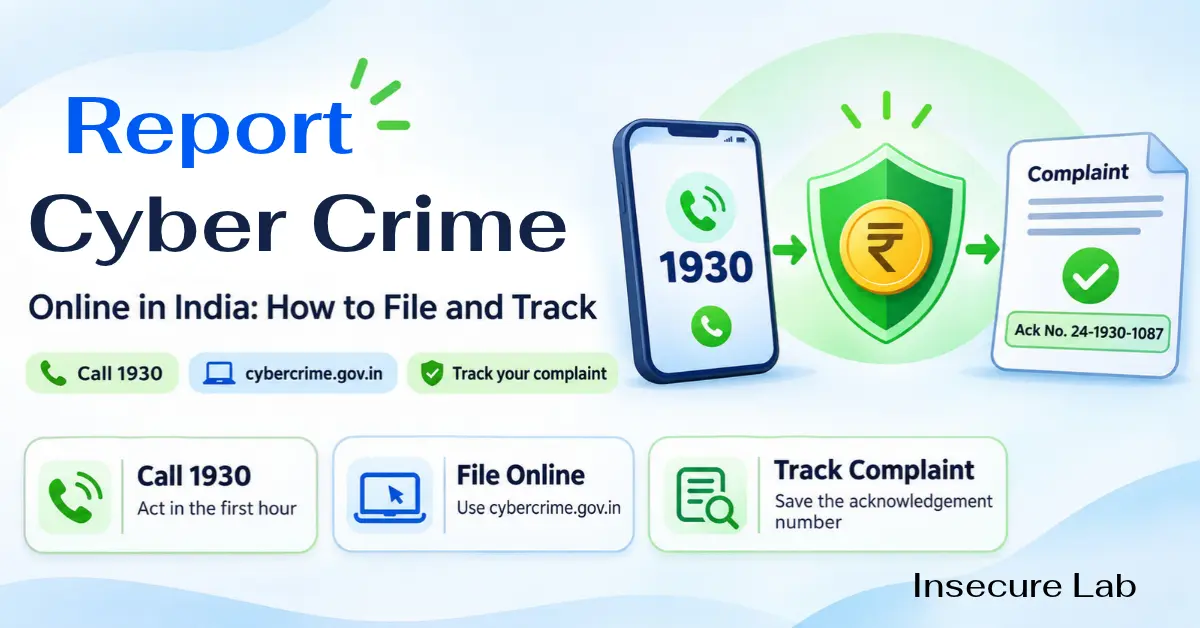
Reporting cyber crime in India comes down to three addresses and one number. Lost money: call 1930 at once, then complete the complaint on cybercrime.gov.in, tell your bank and get an FIR. Everything else: file on cybercrime.gov.in, keeping the evidence intact. Keep the acknowledgement number, track the complaint with it, and if money was held, claim it on mrm-ncrp.mha.gov.in. Report to the bank within days, not weeks, because the RBI’s protections depend on it, and go to the RBI Ombudsman if the bank does not respond. None of this costs anything, which is the simplest test for the recovery scams that follow. This guide is general information, not legal advice.