
Table of Contents
What Is a Digital Arrest?
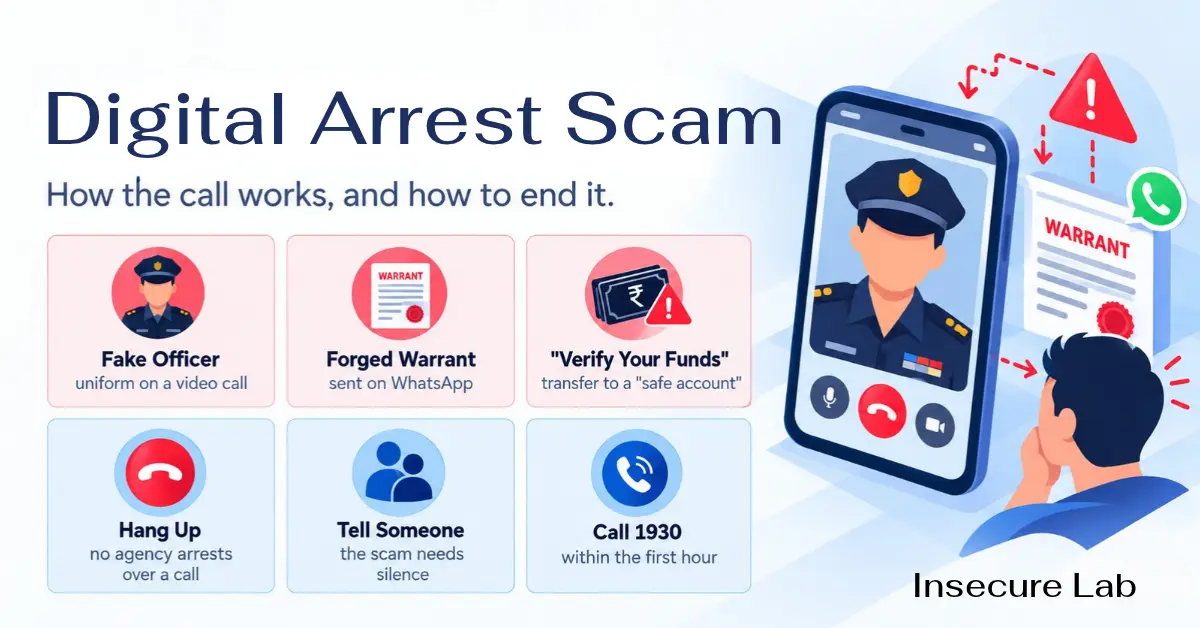
The phrase describes the scam, not a procedure. The caller claims that you are a suspect in a serious case, that a warrant exists, and that you are now under “digital arrest” or “digital custody”: you must stay on the call, keep your camera on, tell no one, and follow instructions until the matter is “verified”. The verification always ends the same way, with your money moved to an account the caller controls.
Indian law has no such concept, and the Government has said so repeatedly since 2024. An arrest is a physical act. The person arrested must be told the grounds, has the right to a lawyer, and must be produced before a magistrate within 24 hours (Article 22 of the Constitution). Police do not hold anyone in custody over WhatsApp, Skype or a video call, and no court, bank or investigating agency asks a citizen to transfer funds so they can be “checked” or “kept safe”. In the Supreme Court’s suo motu case on these scams, the Centre’s own status reports describe digital arrest as an organised, cross-border economic crime.
It belongs to the family of social engineering attacks: nothing is hacked, no malware is involved, and the victim performs every transaction themselves. That is also why the defence is knowledge rather than software.
How the Scam Unfolds, Step by Step
The calls vary in detail but follow one playbook. Knowing the sequence is the best protection, because each stage looks reasonable only if you accepted the one before it.
| Stage | What happens | What it is really doing |
|---|---|---|
| 1. The hook | A call or recorded message about a problem: a parcel in your name held by customs, a SIM used for harassment, a bank account used for money laundering. Press 9 or hold to “speak to an officer”. | Filters for people who respond, and gets you to confirm your name and other details yourself. |
| 2. The hand-off | You are “transferred” to the police, CBI, Narcotics Control Bureau or Enforcement Directorate. The new caller has a name, a rank and a case number, and often appears on video in uniform in front of an office or emblem. | Borrows the authority of a real institution. The uniform and backdrop are props; the video call is on an ordinary app. |
| 3. The accusation | Your Aadhaar or PAN was found in a trafficking, terror-funding or money-laundering case. A forged FIR, arrest warrant, court order or “confidentiality agreement” is shown on screen or sent on WhatsApp. | Creates fear and shame. Forged Supreme Court orders with fake seals and judges’ signatures have been used. |
| 4. The arrest | You are told you are under digital arrest. Stay on camera, do not leave the room, do not tell family or colleagues (“they may be involved” or “you are under a secrecy order”), answer calls only from us. | Isolation. The camera stops you from thinking, searching or asking anyone; the secrecy stops anyone from intervening. |
| 5. The verification | To prove the money in your accounts is legitimate, transfer it to an “RBI account”, a “Supreme Court escrow” or a “government verification account”. It will be returned with a clearance certificate once checked. Fixed deposits are broken, loans are taken, gold is sold. | The theft. The accounts belong to money mules; the funds are split and moved on within hours. |
| 6. The exit | Demands continue as long as money remains: a fine, a bail bond, a fee to release the clearance. When the victim is exhausted or runs out of money, the callers vanish. | Extracts everything reachable. Some victims have been kept on calls for days. |
The Scripts They Use
The opening pretext changes with the news. These are the ones reported most often, and the Government’s own descriptions of the fraud name the first three.
- The courier parcel. A package in your name, usually “to or from” another country, contains drugs, passports or cash. The caller is from the courier company, then from customs, then from the police.
- The SIM or phone number. A number issued on your Aadhaar is being used for harassment or fraud; all your numbers will be disconnected within two hours. The caller claims to be from TRAI or the Department of Telecommunications. Neither body calls subscribers about this.
- The bank account. An account opened with your documents is laundering money for a named criminal. The RBI, the ED or the CBI is now involved.
- The family member. Your son or daughter has been arrested or is in hospital after an incident. Pay now to avoid charges. This version targets parents of students living away from home.
- The tax or Aadhaar notice. An investigation into your PAN or Aadhaar has found irregularities; cooperate on video to avoid arrest.
Whatever the opening, the destination is the same: a video call with an “officer”, a forged document, a secrecy instruction and a transfer. Recognising the shape matters more than recognising the latest script.
Why It Works on Intelligent People
Victims include retired bankers, doctors, professors and senior executives. The scam is not aimed at the gullible; it is aimed at the law-abiding, because people who have never dealt with the police have no idea what a real investigation looks like and every reason to want the problem to go away quietly.
- Authority. Uniforms, case numbers, emblems and legal language switch most people into compliance. Few will challenge someone who appears to be a senior officer.
- Fear and shame. Being named in a drugs or terror case is terrifying even when you know it is false. The secrecy instruction works because the victim does not want family to hear the accusation.
- Isolation and time pressure. Hours on camera, no breaks, no outside contact. Fatigue erodes judgement; the “arrest” frame makes hanging up feel like fleeing.
- A plausible way out. The transfer is framed as cooperation that will be refunded, not as payment. People who would never pay a bribe will “temporarily verify” their savings.
- Details that seem private. Your name, your bank, your courier habits. Most of it you supplied in the first two minutes; the rest is on leaked databases and public profiles. See how much of your digital footprint is public.
The Numbers
The Ministry of Home Affairs gave Parliament the figures reported on the National Cyber Crime Reporting Portal. Later counts come from the Government’s status reports in the Supreme Court. Reported figures understate the problem: many victims never file, out of shame or because they do not know how.
| Period | Digital arrest complaints | Amount lost | Source |
|---|---|---|---|
| 2022 | 39,925 | ₹91.14 crore | MHA, Rajya Sabha, March 2025 |
| 2023 | 60,676 | ₹339.03 crore | MHA, Rajya Sabha, March 2025 |
| 2024 | 1,23,672 | ₹1,935.51 crore | MHA, Rajya Sabha, March 2025 |
| Jan to Feb 2025 | 17,718 | ₹210.21 crore | MHA, Rajya Sabha, March 2025 |
| 2025 (full year) | about 58,000 | not published | I4C status report, Supreme Court, August 2026 |
| Jan to Jun 2026 | 16,377 | not published | I4C status report, Supreme Court, August 2026 |
Two things stand out. Losses grew far faster than complaints between 2022 and 2024, because the scam moved up-market to people with large savings; the average reported loss in 2024 was over ₹1.5 lakh, and individual cases of several crore are common. And complaints have fallen sharply since the peak, which the Government attributes to awareness campaigns, the blocking of spoofed international calls, and the takedown of the accounts used. For context, all cyber fraud reported on the portal cost citizens ₹22,845 crore in 2024 alone; digital arrest is one slice of a much larger problem.
On the enforcement side, the same replies record more than 3,962 Skype IDs and 83,668 WhatsApp accounts blocked for use in digital arrests (as of March 2025), more than 11.14 lakh SIM cards and 2.96 lakh handsets blocked on police reports (as of December 2025), and 24.67 lakh first-layer mule accounts shared with banks through the I4C Suspect Registry, which declined transactions worth about ₹8,031 crore. The 1930 reporting system had put more than ₹8,189 crore on hold across 23.61 lakh complaints by the end of 2025. Those holds are why speed matters if you have paid.
Digital Arrest: How the Response Has Built Up
Government, telecom and judicial milestones that explain today's reporting routes and why the trend turned.
-
Department of Telecommunications
Spoofed international calls blocked
A system to stop foreign calls displaying Indian +91 numbers blocked about 1.35 crore spoofed calls in its first 24 hours; the daily count fell to about 6 lakh within two months.
PIB, December 2024 -
Prime Minister, Mann Ki Baat
"Ruko, socho, action lo"
The national address of 27 October 2024 told citizens there is no digital arrest in law, and to stop, think and report to 1930. Caller-tune and media campaigns followed.
MHA, Rajya Sabha reply -
Ministry of Home Affairs
Scale disclosed to Parliament
1,23,672 complaints and Rs 1,935.51 crore lost in 2024; 3,962 Skype IDs and 83,668 WhatsApp accounts blocked.
Rajya Sabha Q1505 -
Supreme Court of India
Forged Supreme Court orders trigger a suo motu case
A 73-year-old woman in Ambala lost over Rs 1 crore after being shown fake orders bearing the seal of the Court. The Court said forged orders strike at the foundation of public trust and sought responses from the Centre and the CBI.
News on AIR -
Supreme Court of India
CBI made lead agency nationwide
The Court directed the CBI to spearhead a pan-India investigation and to pursue bankers who open mule accounts under anti-corruption law.
MediaNama -
RBI Integrated Ombudsman
Banks ordered to compensate a victim
Five banks were directed to pay Rs 1.31 crore to a 78-year-old retired banker who lost Rs 22.92 crore; the money had been fragmented across 811 accounts at 47 banks with no alerts raised.
Business Today -
Supreme Court of India
RBI told to issue a mule-account SOP
Interim directions: an RBI procedure for temporary debit holds within four weeks, cybercrime coordination centres in every state, money-restoration modules everywhere, and a study of time limits on suspicious audio and video calls. Rs 18.05 crore had been restored to victims in 36,290 cases.
SCC OnLine
Red Flags: Every One of These Is a Tell
Any single item below means the call is a fraud. You do not need two.
- An officer contacts you by phone, WhatsApp, Skype or video call about a case. Real agencies serve notices in writing and expect you to appear in person.
- You are told you are under “digital arrest”, “digital custody” or “online surveillance”, or that you must keep your camera on.
- You are told not to tell your family, your bank or a lawyer, or to keep the matter “confidential under a court order”.
- A warrant, FIR or court order is shown on screen or sent as a PDF on WhatsApp. Genuine ones are not delivered this way.
- You are asked to transfer money to any account to “verify”, “secure”, “audit” or “release” it, or to pay a fine, bond or fee by UPI, transfer, crypto or gift card. The RBI has no customer accounts; courts do not run escrow for suspects.
- The caller knows your name but asks you to “confirm” everything else: bank, address, Aadhaar, parcel details.
- The number is international, shows “International Call” on screen, or starts with +8, +85 or +65 while the caller claims to be an Indian authority.
- Urgency: two hours before your numbers are disconnected, arrest by evening, your name in the press tomorrow.
What to Do During the Call
- Hang up. There is no penalty for disconnecting a call from a stranger, whatever they claim to be. If it is hard to do, say you will call the agency on its published number, then hang up.
- Do not call back on the number they gave, and do not click any link or install any app they send.
- Share nothing. Not your bank name, not an OTP, not a photo of your Aadhaar or PAN, not a view of your room.
- Tell someone immediately. The scam depends on silence. A family member or colleague who hears the story for ten seconds will recognise it.
- If you want certainty, walk into the nearest police station and ask whether any case exists in your name. Do not accept a phone “verification” from the same caller.
- Report the number on the Chakshu facility on Sanchar Saathi. That is for suspicious communication where no money has been lost; it feeds the blocking of numbers and handsets.
If You Have Already Paid
Speed matters more than anything else. The money moves from the first account to dozens of others within hours, but a report made quickly can freeze it in the first layer.
- Call 1930 now or file at cybercrime.gov.in. This reaches the Citizen Financial Cyber Fraud Reporting and Management System, which asks the receiving banks to put the funds on hold. The first hour is the best chance; the first 24 are still worth it.
- Call your bank and report the transactions as fraud. Ask for the transfers to be flagged and the beneficiary accounts to be reported. Note the complaint reference.
- Preserve evidence: the numbers that called, WhatsApp and Skype IDs, screenshots of the documents shown to you, UPI IDs, account numbers and IFSC codes you paid into, and transaction references. Do not delete the chats.
- File an FIR at your local police station or cyber police station. Some states now register an e-Zero FIR automatically from 1930 complaints above a threshold; the Supreme Court has asked all states to adopt it.
- Follow the restoration process. Money frozen through 1930 is returned to victims through a court-ordered process run by the states; the Supreme Court has directed every state to operationalise its money-restoration module.
- If your bank failed you, for instance by letting an elderly customer empty fixed deposits into dozens of unrelated accounts with no alert, escalate to the bank’s grievance cell in writing and then to the RBI Integrated Ombudsman. Compensation has been ordered on exactly those grounds.
- Do not pay anyone who offers to recover your money for a fee. Recovery scams target the same victims a second time.
Protecting Older Family Members
Most victims are senior citizens, often retired professionals with lifetime savings in accessible deposits. A ten-minute conversation now is worth more than any app.
- One rule, said plainly: “No police officer, bank or government office will ever call you about a case, a parcel or a SIM. If anyone does, hang up and call me.” Repeat it. Make it a family joke if that helps it stick.
- Show them this script once, including the uniform on video and the forged warrant, so the first time they see it is not live.
- Turn on the phone’s protections: spam and scam-call filtering, the international-call label where the operator offers it, and silence-unknown-callers if they can live with it.
- Put friction on the money: daily transfer limits, SMS and email alerts to a second family member, and a rule that breaking a fixed deposit or taking a loan waits a day and a phone call.
- Remove the shame. Say in advance that being targeted is not stupidity, that intelligent people lose crores to this, and that calling you mid-scam will be met with help, not blame. Victims stay silent because they fear the lecture.
- Keep 1930 and basic security habits on a card by the phone, next to the family’s own numbers.
FAQs
What is a digital arrest?
Can the police or CBI arrest someone over a video call?
What should I do if I get a digital arrest call?
I have already transferred money. What now?
Why do these scammers know my name, phone number and courier details?
How do I protect elderly parents from digital arrest scams?
Summary
A digital arrest is theatre: a uniform on a video call, a forged document, an order of silence, and a request to “verify” your savings into a stranger’s account. It has no basis in law and no technical component; it works through fear, authority and isolation, and it has taken thousands of crores from careful, educated people. The defence is simple to say and hard to do in the moment, which is why it is worth rehearsing: no officer calls about a case, no one is arrested over a phone, no agency asks for money. Hang up, tell someone, and if money has moved, call 1930 before you do anything else.