
Web Security
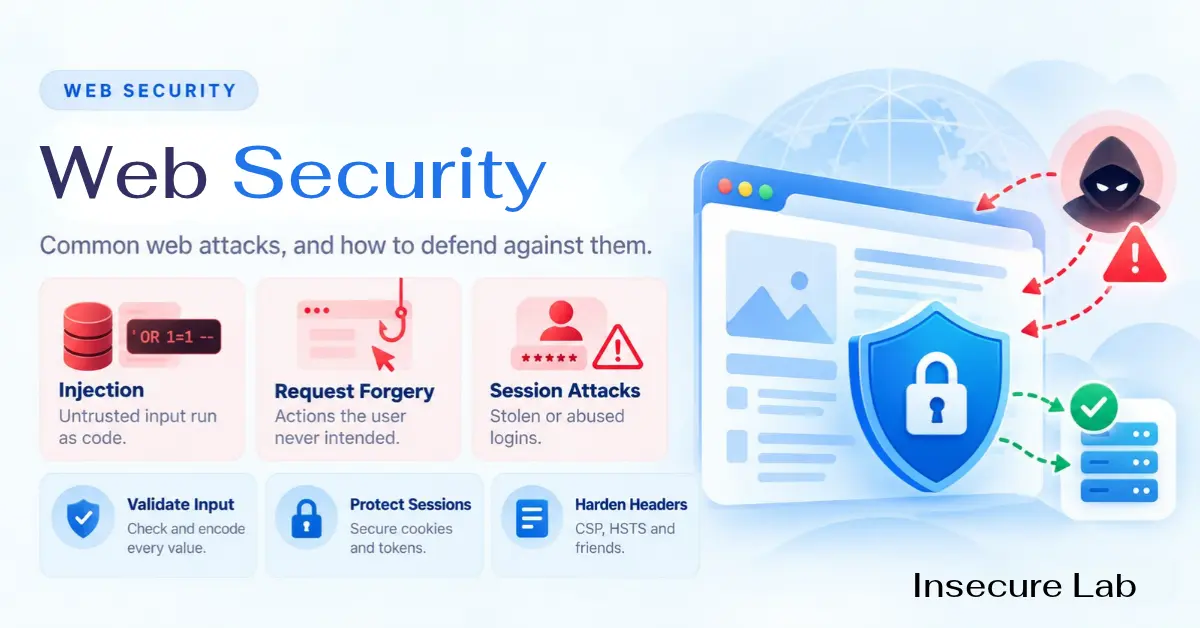
Table of Contents
Quick Answer
Web security is the practice of protecting web applications and their users from attack. Most web attacks come down to one of two mistakes: trusting input that should have been treated as hostile, or trusting that a request really came from the user. This page maps the 21 web security guides on Insecure Lab by class of attack, shows where each sits in the OWASP Top 10:2025, and sets out the defence layers that stop them.
What is Web Security?
A web application takes requests from anyone on the internet, runs code on a server, and sends back pages and scripts that run in someone else's browser. Web security is everything that keeps that arrangement safe: how the application handles untrusted input, how it knows who a user is and keeps their session theirs, what it permits the browser to do, and how it is configured, deployed and tested.
Two things make the web distinctive. The attacker and the victim are often different people, with the application in the middle: a script planted through the site runs in another visitor's browser. And the browser is helpful by design, attaching cookies and following instructions from whichever page it has open. Most of the attacks below abuse one of those two facts.
If your application is mostly endpoints called by apps and other services, read this alongside our API security guide; the ideas are the same and the emphasis differs.
Web Attacks by Class
Every web security guide on this site, grouped by the kind of mistake the attack exploits.
| Class | What goes wrong | Guides |
|---|---|---|
| Injection and input handling | Untrusted input is interpreted as code, a query, a path or a header. | Input Validation Attacks · Cross-Site Scripting (XSS) · SQL Injection · Second-Order SQL Injection · Bobby Tables · XXE Attack · CRLF Injection · Directory Traversal · XSS vs SQL Injection |
| Cross-site and request forgery | Another site makes the browser, or the server, act in the victim's name. | CSRF Attack · Clickjacking · Clickjack Protection · XSS vs CSRF · SSRF vs CSRF |
| Sessions and state | The attacker takes over, plants or rewrites the state that identifies a user. | Session Hijacking · Cookie Tossing · Parameter Tampering |
| Third-party scripts and delivery | Code the site did not write runs in its pages, or a payload is assembled in the browser. | Formjacking · Magecart Attack · HTML Smuggling |
| Testing and assurance | How weaknesses are found before an attacker finds them. | SAST and DAST |
OWASP Top 10:2025 Map
The OWASP Top 10 groups web application risks into ten categories. The table shows where the guides on this site sit in the 2025 edition. Placements follow the weakness identifiers OWASP itself lists under each category, so some may surprise you: clickjacking and parameter tampering fall under Insecure Design, and XXE under Security Misconfiguration.
| Category | Guides on Insecure Lab |
|---|---|
| A01 Broken Access Control | CSRF Attack · Directory Traversal · SSRF vs CSRF · Broken Object Level Authorization |
| A02 Security Misconfiguration | XXE Attack · Security Headers Checklist |
| A03 Software Supply Chain Failures | No dedicated guide |
| A04 Cryptographic Failures | Cryptography |
| A05 Injection | Cross-Site Scripting (XSS) · SQL Injection · CRLF Injection · Input Validation Attacks |
| A06 Insecure Design | Clickjacking · Parameter Tampering · Privilege Escalation |
| A07 Authentication Failures | Session Hijacking · Brute Force Attack · Password Hacking |
| A08 Software or Data Integrity Failures | Formjacking · Magecart Attack |
| A09 Security Logging and Alerting Failures | Intrusion Detection System |
| A10 Mishandling of Exceptional Conditions | No dedicated guide |
This is an independent educational mapping by Insecure Lab. It is not affiliated with or endorsed by OWASP. The official list is linked under Sources. For a working review list, use our OWASP Top 10 Checklist.
Defence Layers
No single control stops everything. Web security works in layers, so that when one is missing or bypassed, another still holds.
| Layer | What it does | Read more |
|---|---|---|
| Validate input, encode output | Treat every value from the browser as untrusted; encode it for the context it lands in. | Input Validation Attacks · XSS |
| Parameterised queries | Keep data and commands separate, so input can never change the shape of a query. | SQL Injection |
| Protect sessions and cookies | Secure, HttpOnly, SameSite cookies; rotate session identifiers at login; require proof of intent on state changes. | Session Hijacking · CSRF |
| Authorize on the server | Never trust a value because the interface would not have sent it. Check the record, the action and the fields. | Parameter Tampering · API Security |
| Security headers | Content Security Policy, HSTS and frame restrictions tell the browser what the page is allowed to do. | Security Headers Checklist · Clickjacking |
| Control third-party scripts | Load only what you need, pin it with integrity hashes, and restrict where scripts may come from. | Formjacking |
| Test in the pipeline | Static and dynamic analysis on every change, plus a checklist review before release. | SAST and DAST · OWASP Top 10 Checklist |
Learning and Testing Safely
- Practise on intentionally vulnerable training applications, in a local lab, or on systems you own.
- Test anything else only with written permission and an agreed scope.
- Learn each attack together with its defence. Knowing why encoding stops XSS is more useful than knowing ten payloads.
- Check what you learn against primary sources: OWASP, MDN and the standards themselves change, and tutorials go stale.
Web Security Learning Path
FAQs
Sources and further reading
- OWASP Top 10:2025 — The ten categories and the weaknesses mapped to each
- OWASP Top Ten Project — Project home and earlier editions
- MITRE - 2025 CWE Top 25 Most Dangerous Software Weaknesses — XSS, SQL injection and CSRF rank first, second and third
- OWASP Web Security Testing Guide — How each class of weakness is tested for
- OWASP Cheat Sheet Series — Defensive guidance by topic
- OWASP Cheat Sheet Series - Session Management — Session identifiers, cookies and expiry
- OWASP Cheat Sheet Series - HTTP Headers — Security headers and what each one controls
- MDN Web Docs - Web security — Browser security model and platform features